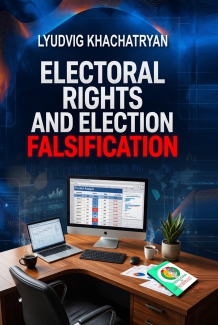
ELECTORAL RIGHTS AND ELECTION FALSIFICATION:
Electoral Systems, Fraud Mechanisms, and Methods of Objective Evaluation
Book offers a thorough examination of how electoral systems work, how election fraud occurs, and how it can be detected using objective analysis. Drawing on comparative research and decades of study, Lyudvig Khachatryan examines the legal foundations of suffrage, the mechanics of majoritarian and proportional systems, and the vulnerabilities that allow manipulation of election outcomes.The book delves beyond theory to examine the rationale and technologies of election fraud, such as pre-election abuses, ballot stuffing, vote-counting abnormalities, and flaws in judicial oversight. It also presents practical methods for reducing fraud through stronger legislation, transparent procedures, improved data publication, and modern monitoring tools.
This paper makes a significant contribution by using mathematical and statistical approaches to assess turnout, voting trends, and mandate distribution. Khachatryan introduces analytical approaches for comparing election numbers, identifying anomalies, and estimating the impact of fraudulent votes on final results. Case studies from Armenia and Russia, along with observations on U.S. presidential elections, illustrate how these methods can be applied in real-world contexts.
Written for election specialists, policymakers, commissioners, observers, researchers, and students, this book combines legal analysis, political insight, and quantitative methodology to provide a serious framework for understanding electoral integrity. It is both a study of the weaknesses that undermine democracy and a practical guide to building fairer, more accountable electoral systems.